History of Iconic Designer Handbags
The designer handbag as we know it today is a relatively modern invention, but its roots stretch back nearly two centuries. From Louis Vuitton's trunks in 1854 to FENDI's cashmere shoppers in 2024, the luxury handbag has evolved from a functional necessity into the single most powerful status symbol in fashion.
Understanding the history behind the brands and bags you're buying isn't just trivia — it's a practical advantage. Heritage brands with deep roots (Gucci, Prada, Louis Vuitton, FENDI) tend to hold their resale value better, and knowing the design lineage of a bag helps you distinguish genuine craftsmanship from trend-chasing imitations. This article traces the major milestones that shaped the luxury handbag industry, with direct connections to the bags we review on this site.
Every brand in our catalog — from century-old Italian houses to modern American labels — has a story that informs the quality, design philosophy, and value of the bags they produce today.
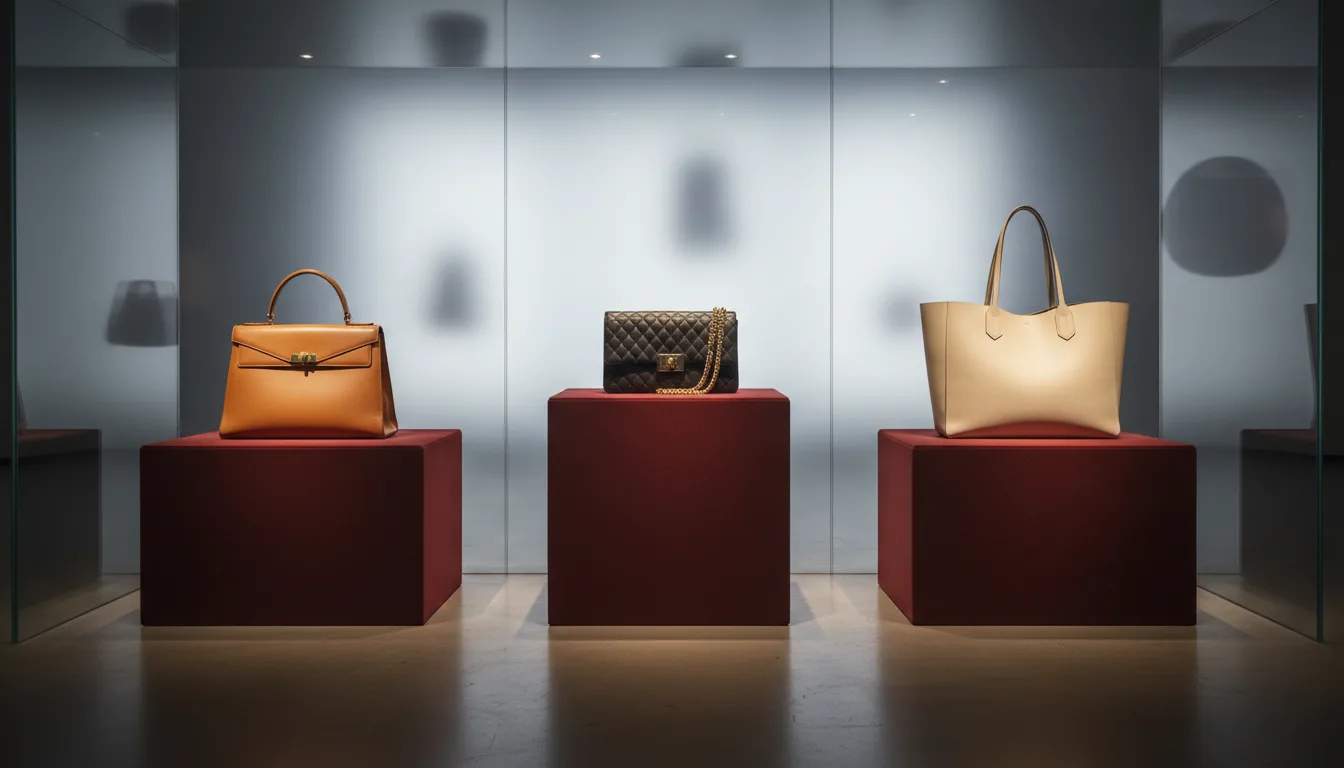
The Foundations: 1854 to 1930
The luxury handbag industry traces its origins to European trunk makers and leather goods artisans who served the traveling aristocracy. Louis Vuitton, founded in 1854 in Paris, began as a trunk-making workshop. Vuitton's flat-topped trunks were revolutionary — they stacked efficiently on trains and steamships, solving a practical problem for the wealthy. The iconic LV monogram canvas, introduced in 1896 by Louis's son Georges, was originally designed as an anti-counterfeiting measure. That same monogram appears on the Louis Vuitton Pochette Accessoires we review today.
Prada opened its doors in 1913 in Milan's Galleria Vittorio Emanuele II as Fratelli Prada, selling leather goods, trunks, and imported English steamer bags. The brand earned the coveted title of official supplier to the Italian Royal Household in 1919 — a distinction that cemented Prada's reputation for uncompromising quality before the concept of "luxury branding" even existed.
Gucci was founded in 1921 by Guccio Gucci in Florence, drawing inspiration from the refined luggage he'd observed while working at the Savoy Hotel in London. Meanwhile, FENDI began in 1925 as a small fur and leather shop on Via del Plebiscito in Rome, run by Adele and Edoardo Fendi. These four houses — Louis Vuitton, Prada, Gucci, and FENDI — would go on to dominate luxury handbags for the next century.
When you buy from a brand founded before 1930, you're buying into a design vocabulary refined over nearly a century. The Prada Esplanade's saffiano leather, for example, uses a cross-hatch stamping technique that Prada patented in 1913 — the same year the house was founded.
The Birth of the Modern Handbag: 1930s to 1960s
The 1930s marked the transition from luggage-focused leather goods to purpose-designed handbags. Hermes introduced what would become the Kelly bag in 1935 (originally called the Sac a depeches), designed as a smaller, more feminine accessory for everyday use. When Grace Kelly was photographed carrying one in 1956, it was renamed in her honor — creating the first "celebrity handbag" moment in fashion history.
Salvatore Ferragamo, who had already earned fame as Hollywood's shoemaker to the stars, expanded into leather goods and handbags during this period. The Gancini hook — Ferragamo's signature hardware motif — became one of the most recognizable closures in luxury fashion. Today, that same Gancini lock graces the Ferragamo Studio Box Top-Handle Bag we review, connecting modern buyers to decades of Italian craftsmanship.
The 1950s brought Chanel's revolutionary 2.55 bag (February 1955), which introduced the chain strap that freed women's hands. This innovation echoes through modern designs — both the Gucci Soho Leather Flap (gold chain strap) and the Gucci Interlocking GG Chain Bag (curb chain shoulder strap) are direct descendants of Chanel's chain-strap revolution.
During the 1960s, Versace founder Gianni Versace was still a young man apprenticing in his mother's dressmaking studio in Calabria, Italy. He would launch his own label in 1978, bringing a bold, maximalist aesthetic that stood in stark contrast to the understated luxury of Ferragamo and Prada. The gold Medusa emblem — seen on the Versace Medusa Clutch — was inspired by ancient Greek mythology, symbolizing an irresistible allure.
The Logo Era and Nylon Revolution: 1970s to 1990s
Gucci's interlocking GG monogram, introduced in the 1960s and popularized throughout the 1970s, launched the era of logo-driven luxury. The GG pattern became shorthand for Italian prestige, and its influence is still visible in bags like the Gucci GG Canvas Belt Bag, which uses the original GG canvas alongside Gucci's heritage green-red web stripe.
The most disruptive moment in handbag history came in 1984, when Miuccia Prada introduced the Pocono nylon backpack. By using industrial-grade nylon — the same material as military parachutes — and pricing it at luxury levels, Prada challenged the fundamental assumption that luxury must mean leather. The Prada Tessuto Nylon Tote in our catalog is a direct descendant of this philosophy: tessuto nylon with calf leather trim, proving that material innovation can coexist with luxury positioning.
Did you know? Prada's saffiano leather — the cross-hatched, heat-stamped finish on the Prada Esplanade — was actually patented by Mario Prada in 1913. Miuccia Prada revived and modernized the technique in the 1990s, making it Prada's signature material. Saffiano is now imitated across the industry, but Prada holds the original process.
The late 1980s and 1990s saw FENDI's breakthrough moment: the Baguette bag (1997), designed by Silvia Venturini Fendi. Named because it was carried under the arm like a French baguette, it became the first true "It Bag." FENDI's FF monogram, originally designed by Karl Lagerfeld in 1965, became a status symbol on par with Gucci's GG and Louis Vuitton's LV. Today, FENDI continues pushing boundaries with designs like the Fendigraphy Leopard Hobo and the FF Cashmere Shopper — a tote made from knitted cashmere wool rather than leather.
The Rise of Accessible Luxury: 2000s to 2010s
Coach, founded in 1941 as a small family-run workshop in Manhattan, transformed the luxury handbag market by creating the "accessible luxury" category. While European houses priced bags at $1,000 and above, Coach offered genuine leather bags with serious craftsmanship in the $300-$500 range. The brand's modern resurgence, led by creative director Stuart Vevers from 2013, produced icons like the Coach Tabby Shoulder Bag 26 — a bag that delivers buttery calf leather and a sculptural brass C closure at under $500.
Kate Spade (founded 1993) and Michael Kors (founded 1981, handbags from 2004) followed Coach's playbook, proving there was massive demand for well-designed bags in the $300-$500 range. The Kate Spade Knott Hobo ($300–$500) and Michael Kors Kensington ($300–$500) represent this democratic approach to designer accessories — genuine leather, thoughtful design, and brand recognition without the four-figure barrier.
American heritage brand Frye, with roots stretching back to 1863, entered the handbag market with the same full-grain leather philosophy that made their boots legendary. The Frye Melissa Shopper at Under $300 uses Italian antique pull-up leather — the same grade of material found in bags costing three to four times as much — proving that brand heritage doesn't always correlate with price.
The accessible luxury tier (under $300 to $500) offers the best craftsmanship-per-dollar in the designer handbag market. Bags like the Coach Tabby and Brahmin Duxbury compete on material quality with bags costing $1,000+, while brands like Gucci and Prada charge a premium for heritage prestige and Italian manufacturing.
The Modern Era: 2020s and Beyond
Today's luxury handbag market is defined by several converging trends. First, the resale market has exploded — platforms like The RealReal, Vestiaire Collective, and Rebag have made "investment value" a legitimate buying criterion. Louis Vuitton, Gucci, and Prada bags routinely hold 50-80% of their retail value on the secondary market.
Second, material innovation is replacing material tradition. FENDI's FF Cashmere Shopper is made from knitted cashmere wool — not leather — yet carries a $2,500+ price tag that reflects its craftsmanship and rarity. Tory Burch's Ella Hand-Crocheted Tote uses artisan crochet construction, making each bag slightly unique. These designs prove that luxury in the 2020s is about artisanal uniqueness, not just premium leather.
Third, the digital marketplace has democratized access. Amazon Luxury Stores now sells authenticated designer bags from Prada, Versace, and more, with the platform's buyer protections and fast shipping. Read our guide to Amazon Luxury Stores to understand how authentication works. Every bag we review is available through Amazon, combining heritage luxury with modern convenience.
Fourth, the "quiet luxury" movement — driven by shows like Succession and social media backlash against overt logos — has renewed interest in understated pieces. The Ferragamo Studio Box (subtle Gancini lock), the Marc Jacobs Belted Suede (minimal branding), and the Brahmin Duxbury Satchel (quality-over-logos) all reflect this shift toward discreet luxury.
How History Informs Your Buying Decision
Understanding a brand's history isn't academic — it directly impacts value, quality, and longevity. Brands with deep roots tend to maintain stricter quality control, hold resale value better, and produce designs that outlast trends. Here is how each brand in our catalog connects to its heritage:
- Louis Vuitton (1854) — The monogram canvas on the Pochette Accessoires uses a formula unchanged since 1896. LV bags consistently command the highest resale values in the accessible luxury segment.
- Prada (1913) — Saffiano leather was patented the year Prada was founded. The Esplanade and Vitello Phenix Tote both showcase materials Prada has perfected over a century.
- Gucci (1921) — Florence leather craftsmanship defines the Soho Flap and Interlocking GG Chain. The GG monogram was designed to honor founder Guccio Gucci's initials.
- FENDI (1925) — From a Roman fur shop to one of fashion's most innovative houses. The FF Cashmere Shopper and Fendigraphy Leopard push material boundaries while honoring the house's artisan DNA.
- Ferragamo (1927) — Salvatore Ferragamo's shoemaking precision translates directly to the structured perfection of the Studio Box.
- Coach (1941) — American leather heritage. The Tabby 26 represents Coach's evolution from practical leatherworker to modern luxury brand.
- Kate Spade (1993), Michael Kors (1981), Brahmin (1982) — The accessible luxury wave that proved great design and quality materials belong at every price point.
Frequently Asked Questions
What is the oldest luxury handbag brand still operating today?
Louis Vuitton, founded in 1854, is among the oldest luxury handbag brands still operating today. The house began as a trunk-making atelier in Paris and expanded into handbags in the early 20th century. Prada (1913), Gucci (1921), and FENDI (1925) also have roots stretching back more than a century.
When did designer handbags become status symbols?
Designer handbags became mainstream status symbols in the 1980s and 1990s, driven by the rise of logo-centric fashion, celebrity culture, and global luxury advertising. However, brands like Louis Vuitton and Hermes had cultivated exclusivity among the wealthy since the early 1900s. The "It Bag" phenomenon of the late 1990s and early 2000s cemented handbags as the dominant luxury accessory category.
Who invented the modern handbag?
The modern structured handbag evolved gradually through the 19th and early 20th centuries. Samuel Parkinson commissioned one of the first known handbags for his wife in the 1860s. However, the concept of a designer-branded luxury handbag as we know it today was pioneered by houses like Louis Vuitton (trunks-to-bags), Hermes (the Kelly bag in the 1930s), and Chanel (the 2.55 flap bag in 1955).
What made Prada nylon bags revolutionary?
When Miuccia Prada introduced the Pocono nylon backpack in 1984, it challenged the assumption that luxury must mean leather and gold hardware. By using industrial-grade nylon — the same material as military parachutes — and pricing it at luxury levels, Prada proved that design, brand, and intellectual creativity could define luxury, not just raw materials. This philosophy continues in bags like the Prada Tessuto Nylon Tote we review on this site.
What is the most iconic designer handbag of all time?
While subjective, the Hermes Birkin (introduced 1984), Chanel 2.55 (1955), and Louis Vuitton Speedy (1930s) are generally considered the most iconic designer handbags in fashion history. Each defined a new era of luxury accessories and remains in high demand decades after its debut. Among the bags we review, the Louis Vuitton Pochette Accessoires and the Gucci Soho carry that same legacy of timeless design.
How have designer handbag prices changed over the decades?
Designer handbag prices have increased dramatically, especially since 2010. A Chanel Classic Flap that cost approximately $1,150 in 1990 now retails for over $10,000. Louis Vuitton, Gucci, and Prada have all implemented annual price increases of 5-15%. However, brands like Coach, Kate Spade, and Michael Kors have created an "accessible luxury" tier, offering genuine designer bags under $500.
Why do some designer bags increase in value over time?
Certain designer bags appreciate due to scarcity (limited production), brand prestige (Hermes, Chanel, Louis Vuitton), discontinuation (retired styles become collector items), and cultural significance (bags associated with celebrities or historic moments). The pre-owned luxury market, driven by platforms like The RealReal and Vestiaire Collective, has made resale value a genuine consideration for buyers.