Designer Handbag Terminology and Features Glossary
The luxury handbag world has its own language — saffiano, vachetta, Gancini, GG Supreme, turnlock, strap drop. This glossary defines every term you'll encounter when shopping for designer bags, with direct connections to the specific products in our catalog so you can see each concept in context.
Whether you're buying your first designer bag or your fifteenth, knowing the precise terminology helps you evaluate quality, compare products accurately, and understand exactly what you're paying for. A "pebbled leather shoulder bag with a turnlock closure" and a "saffiano leather top-handle with a padlock closure" are fundamentally different bags — and this glossary makes sure you know why.
We've organized terms into five categories: leather and materials, bag styles and silhouettes, hardware and closures, construction and features, and brand-specific terms. Each definition connects to real bags in our catalog so the terms aren't abstract — they're tied to products you can actually examine and purchase.
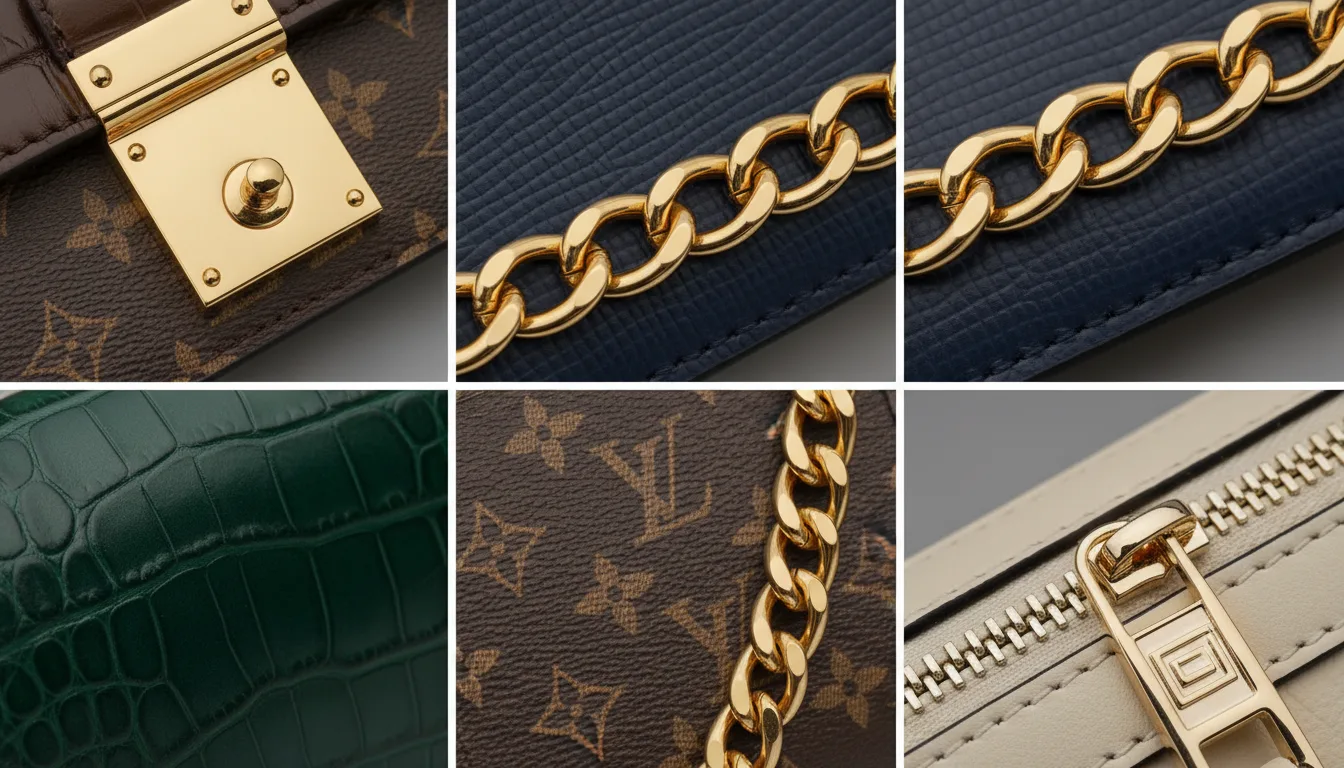
Leather and Material Terms
Saffiano Leather
A cross-hatch textured leather created by a heat-stamping process that Prada patented in 1913. The diagonal pattern is pressed into the leather under high heat, creating a stiff, structured surface that resists scratches, water, and stains better than almost any other leather finish. Saffiano is Prada's signature material — the Prada Esplanade ($1,500–$2,500) showcases saffiano at its finest. The technique has been widely imitated across the industry, but Prada's saffiano remains the benchmark for quality.
Vitello Phenix Leather
Prada's pebbled calfskin leather with a naturally tumbled grain. "Vitello" means "calf" in Italian. Vitello Phenix is Prada's most durable leather — engineered specifically for daily use, it resists scratches and scuffs better than saffiano while offering a softer, more relaxed feel. The Prada Vitello Phenix Tote ($1,500–$2,500) demonstrates this leather's balance of toughness and elegance.
Pebbled Leather
Leather with a naturally bumpy, textured surface created by tumbling the hide in a drum during the tanning process. The irregular pattern hides scratches and wear marks, making pebbled leather one of the most practical choices for everyday bags. Used across multiple brands in our catalog: the Gucci Soho Flap, Michael Kors Kensington, Ferragamo Studio Box, and Kate Spade Knott Hobo all use pebbled leather.
Vachetta Leather
An untreated, undyed cowhide leather most associated with Louis Vuitton. Vachetta starts as a pale, creamy color and develops a golden-brown patina through exposure to sunlight, natural skin oils, and time. This aging process is intentional and prized by collectors — a dark, even vachetta patina is considered a mark of an authentically loved bag. The Louis Vuitton Pochette Accessoires uses vachetta for its strap and trim. Vachetta is vulnerable to water stains before the patina develops, so new bags require careful handling for the first few months.
Pull-Up Leather
A type of full-grain leather treated with oils and waxes that create a distinctive color-shift effect when the leather is flexed or pulled. The lighter areas that appear when the leather is stretched are the oils redistributing — they return to their original tone when the leather relaxes. Pull-up leather develops a rich patina with age and use. The Frye Melissa Shopper (Under $300) uses Italian antique pull-up leather, giving each bag a unique character that deepens over time.
Calfskin / Calf Leather
Leather from young cattle, prized for its fine grain, softness, and uniformity. Calfskin is the standard material for most high-end luxury bags because it takes dyes evenly and can be finished in multiple ways — smooth, pebbled, or embossed. The Coach Tabby 26 uses smooth calf leather, while the Ferragamo Studio Box uses pebbled calfskin.
Croc-Embossed Leather
Cowhide leather stamped with a crocodile-scale pattern to mimic the look of genuine exotic leather at a fraction of the cost. The embossing creates a textured surface with depth and visual interest that catches light beautifully. The Brahmin Duxbury Satchel ($300–$500) uses Melbourne croc-embossed leather — one of the most convincing and well-executed croc-embossing treatments in the market.
Suede
The soft, napped underside of leather, sanded to create a velvety texture. Suede is more delicate than finished leather — vulnerable to water, stains, and abrasion — but offers a warm, textured aesthetic that smooth leather cannot replicate. The Marc Jacobs Belted Suede Shoulder Bag ($300–$500) showcases brown suede at its best. Suede requires protective spray treatment and careful storage.
Tessuto Nylon
"Tessuto" means "fabric" in Italian. In the luxury handbag context, it refers specifically to Prada's signature industrial-grade nylon — the same material used in military parachutes. Miuccia Prada introduced tessuto nylon in 1984, challenging the assumption that luxury must mean leather. The Prada Tessuto Nylon Tote ($1,000–$1,500) demonstrates how this lightweight, water-resistant fabric works as a luxury material when paired with fine leather trim and gold hardware.
Monogram Canvas / Coated Canvas
A fabric base (cotton or linen) coated with a durable, water-resistant PVC or resin layer, then printed with a brand's signature pattern. Despite its leather-like appearance, monogram canvas is not leather — it's a coated fabric designed for durability and water resistance. Louis Vuitton's monogram canvas (on the Pochette Accessoires) and Gucci's GG canvas (on the GG Canvas Belt Bag) are the most famous examples. Dooney & Bourke also uses coated canvas on the Gretta Satchel.
Cashmere Wool
Ultra-soft fiber from cashmere goats, used in luxury textiles and — increasingly — in innovative bag designs. Cashmere is rare, expensive, and requires specialized care. The FENDI FF Cashmere Shopper ($2,500+) is the most notable example in our catalog — an entire tote constructed from knitted cashmere wool rather than leather, representing FENDI's material innovation.
Lamb Fur / Shearling
Genuine animal fur or sheepskin with the wool still attached, used for linings, trims, or full exterior construction. Lamb fur offers exceptional softness and a statement-making texture. The FENDI Fendigraphy Leopard ($2,500+) uses leopard-print lamb fur for its entire exterior — a bold choice that requires specialized care and storage.
If daily durability is your priority, here is how common luxury materials rank from most to least resilient: saffiano leather (virtually indestructible) > coated canvas (water-resistant, easy to clean) > pebbled leather (hides scratches) > smooth calfskin (shows wear faster) > suede (requires constant care) > cashmere/fur (most delicate). Match the material to your lifestyle before committing to a purchase.
Bag Styles and Silhouettes
Tote
A large, open-top bag with two parallel handles, designed for maximum carrying capacity. Totes are the workhorses of the handbag world — ideal for work, travel, and daily errands. Styles range from structured (the Prada Vitello Phenix) to unstructured (the Frye Melissa Shopper) to avant-garde (the FENDI Cashmere Shopper).
Satchel
A structured, enclosed bag with a flat bottom, rigid sides, and a top handle. Satchels maintain their shape whether full or empty, making them the most professional-looking bag style. The Prada Esplanade, Brahmin Duxbury, and Dooney & Bourke Gretta are all satchels.
Hobo
A crescent-shaped bag that curves and slouches when carried, creating a relaxed, effortless silhouette. The name comes from the bindle bags carried by American hobos. Modern hobo bags range from bohemian (Kate Spade Knott Hobo) to sculptural (FENDI Fendigraphy Leopard).
Shoulder Bag
Any bag designed to be worn on the shoulder via one or two straps. This is the broadest style category, encompassing flap bags, chain bags, and soft-body bags. The Gucci Soho Flap, Coach Tabby 26, and Marc Jacobs Belted Suede are all shoulder bags with distinct personalities.
Crossbody
A bag worn across the body via a long strap that goes from one shoulder to the opposite hip. Crossbody bags offer hands-free convenience and security — the weight is distributed evenly and the bag stays close to your body. Many bags in our catalog convert to crossbody wear: the Coach Tabby 26 (detachable strap), the Brahmin Duxbury (detachable strap), and the Prada Tessuto Tote (adjustable strap).
Clutch
A small, strapless bag designed to be held in the hand or tucked under the arm. Clutches are evening bags — compact, elegant, and intentionally limited in capacity. The Versace Medusa Clutch ($1,000–$1,500) is the quintessential luxury clutch, though it includes a detachable chain strap for versatility.
Pochette
A French term meaning "small pocket" — a pochette is a flat, compact bag typically under 10 inches wide. Pochettes are smaller than crossbodies and larger than card cases, sitting in the space between a clutch and a proper handbag. The Louis Vuitton Pochette Accessoires is the definitive pochette design — compact enough for essentials, versatile enough for multiple carrying styles.
Belt Bag / Waist Bag
A bag worn around the waist via an adjustable strap — the modern, luxury evolution of the 1990s fanny pack. Belt bags offer supreme hands-free convenience and have become a staple of streetwear-influenced luxury fashion. The Gucci GG Canvas Belt Bag ($500–$1,000) combines heritage GG canvas with the belt bag format.
Shopper
A large, open-top tote designed for generous capacity — traditionally used for shopping but now a statement piece in luxury fashion. Shoppers are typically wider and more relaxed than structured totes. The Frye Melissa Shopper and FENDI FF Cashmere Shopper are both shoppers.
Top-Handle
A bag with a single rigid handle on top, designed to be carried by hand or in the crook of the elbow. Top-handle bags are among the most formal bag styles — they evoke vintage glamour and professional polish. The Ferragamo Studio Box and Prada Esplanade are both top-handle designs.
Convertible bags: Many modern luxury bags blur the lines between styles by offering multiple carrying options. The Prada Tessuto Nylon Tote converts five different ways — top handle, shoulder, tote, crossbody, or document bag. Always check for detachable or adjustable straps when evaluating a bag's versatility.
Hardware and Closure Terms
Turnlock
A rotating metal clasp that twists 90 degrees to lock and unlock. Turnlocks are among the most iconic closure types in luxury handbags — Chanel's CC turnlock, Gucci's interlocking GG turnlock, and Coach's sculptured C are all variations. The Gucci Interlocking GG Chain Bag uses Gucci's signature double-G turnlock as both a functional closure and a branding element.
Gancini
Salvatore Ferragamo's signature hardware motif — an interlocking hook design introduced in 1969. "Gancini" means "little hook" in Italian. The Gancini appears as clasps, buckles, and decorative elements across Ferragamo's bag collection. On the Ferragamo Studio Box, the gold Gancini serves as the primary lock closure — elegant, functional, and immediately identifiable.
Medusa
Versace's iconic brand emblem — the head of Medusa from Greek mythology. Gianni Versace chose Medusa because, according to myth, those who looked at her were frozen — unable to look away. The gold Medusa head appears as hardware on Versace bags, including the Versace Medusa Clutch, where it serves as both a decorative element and a magnetic closure mechanism.
Magnetic Snap
A concealed magnetic closure embedded in the fabric or leather of a bag's flap or opening. Magnetic snaps provide easy one-handed access while keeping the bag securely closed. Used on the Gucci Soho Flap, Michael Kors Kensington, and Kate Spade Knott Hobo.
Padlock Closure
A decorative (and sometimes functional) padlock attached to the bag, typically with a small key on a leather lanyard. Padlock closures are a hallmark of Italian luxury — Hermes, Prada, and Saint Laurent all use them. The Prada Esplanade features a gold padlock with a Prada-branded key, adding an extra layer of security and visual refinement.
Chain Strap
A strap made from interlocking metal links, either fully metal or with leather woven through. Chain straps originated with Chanel's 2.55 bag in 1955 and remain a staple of luxury shoulder bags. The Gucci Soho Flap (gold chain) and Gucci Interlocking GG (heavy curb chain) both feature chain straps with different aesthetics — the Soho's chain is delicate and feminine, while the Interlocking GG's curb chain is bold and substantial.
Gold-Tone / Silver-Tone Hardware
Metal hardware with a gold or silver finish. "Gold-tone" means the metal is plated or coated to look like gold — it is not solid gold. Most luxury bags use gold-tone hardware, which can range from warm yellow gold (Gucci, FENDI) to pale champagne gold (Prada) to rose gold (some Coach and Kate Spade pieces). The finish should be uniform with no visible plating boundaries.
Zipper Pull
The tab or charm attached to a zipper slider that makes it easier to grip and pull. On luxury bags, zipper pulls are often branded (engraved with the designer's logo or name) and made from high-quality metal. Some bags use leather zipper pulls for a softer aesthetic. Check zipper manufacturers — luxury bags typically use YKK, Lampo, or Riri zippers.
Protective Feet
Small metal studs on the bottom of a bag that protect the base from contact with surfaces. Protective feet prevent scratches, moisture damage, and dirt accumulation on the bag's bottom. The Brahmin Duxbury Satchel features gold protective feet — a practical detail that signals quality construction.
When examining a luxury bag's hardware in person, check for three things: weight (genuine luxury hardware has noticeable heft — it should feel solid, not hollow), engravings (brand markings should be crisp and perfectly centered), and finish uniformity (no patches of different color, no visible seams where metal parts join). These three checks catch 90% of counterfeit hardware.
Construction and Feature Terms
Strap Drop
The distance from the top of the strap (where it attaches to the bag) to the highest point of the bag. Strap drop determines how and where the bag sits on your body. A 4-5 inch drop means hand-carry. A 9-10 inch drop fits comfortably on the shoulder. A 20-22 inch drop works as a crossbody. Always check strap drop measurements — a beautiful bag with the wrong drop length becomes uncomfortable within minutes. See our size guide for detailed strap drop recommendations by body type.
Dust Bag
A soft fabric pouch included with luxury bags for storage and protection. Dust bags prevent scratches, dust accumulation, and color transfer when the bag is not in use. Each brand uses a distinctive dust bag: Gucci (white with GG logo), Prada (navy blue with gold text), FENDI (yellow with black FF), Louis Vuitton (beige with brown LV). The presence and quality of a dust bag is a basic authenticity indicator. See our care guide for proper dust bag usage.
Serial Number / Date Code
A unique identifier stamped or printed inside a luxury bag that indicates manufacturing details. Different brands use different systems: Gucci uses a numeric serial number on an interior leather tag, Prada uses a factory code on their authenticity card, and Louis Vuitton uses date codes (letters indicating the factory, numbers indicating the date of manufacture). Serial numbers are critical for authentication and resale.
Authenticity Card / Certificate
A card or document included with the bag that certifies its authenticity, typically including a serial number, QR code, or hologram. Brands like Prada, FENDI, and Ferragamo include authenticity cards; Louis Vuitton does not (they rely on date codes instead). Always keep authenticity cards — they significantly increase resale value.
Lining
The fabric inside the bag. Luxury bags use various lining materials: suede-like microfiber (the Gucci Interlocking GG), nylon (the Prada Vitello Phenix), cotton (the Frye Melissa), branded fabric (the Brahmin Duxbury), or leather (the Ferragamo Studio Box). Leather lining is the most premium; fabric lining is the most practical (lighter, easier to clean).
Interior Compartments
Divided sections, pockets, and organizational features inside the bag. Some bags prioritize organization (multiple zip pockets, phone slots, card holders), while others offer a single open compartment for maximum flexibility. Structured bags like satchels typically have more compartments; totes and hobos often have open interiors.
Convertible / Two-Way / Multi-Way
A bag that can be carried in multiple configurations using detachable or adjustable straps. The Prada Tessuto Nylon Tote is the most versatile bag in our catalog — it converts five different ways. Convertible bags offer the best value because you effectively get multiple bags in one purchase.
Brand-Specific Terms
GG (Gucci)
The interlocking double-G monogram representing founder Guccio Gucci's initials. Introduced in the 1960s, the GG pattern appears on canvas, leather (embossed), and hardware across Gucci's entire collection. On bags like the GG Canvas Belt Bag, the GG pattern is printed on canvas; on the Soho Flap, a single GG is embossed into the leather.
FF (FENDI)
The double-F monogram standing for "Fun Furs" — FENDI's original tagline when Karl Lagerfeld designed the logo in 1965. The inverted FF pattern appears on canvas, knit materials, and hardware. The FF Cashmere Shopper features the FF pattern knitted directly into the cashmere fabric.
Monogram (Louis Vuitton)
The LV initials combined with four-pointed stars, curved diamonds, and a circle with a four-leaf clover — the pattern created by Georges Vuitton in 1896 as an anti-counterfeiting measure. The monogram canvas is Louis Vuitton's most recognizable material, appearing on the Pochette Accessoires and across LV's core collection.
Web Stripe (Gucci)
Gucci's iconic green-red-green (or blue-red-blue) striped ribbon, inspired by traditional equestrian saddle girths. The web stripe is one of Gucci's oldest design elements, predating the GG monogram. On the GG Canvas Belt Bag, the green-red web stripe runs across the front, combining two of Gucci's most recognizable heritage elements.
Fendigraphy (FENDI)
A modern bag silhouette introduced by FENDI featuring a sculptural, asymmetric hobo shape with gold FENDI lettering at the base. The name combines "FENDI" and "graphy" (writing), referencing the brand name inscription. The FENDI Fendigraphy Leopard is the statement-making version of this design.
Tabby (Coach)
Coach's modern signature bag, featuring a sculpted brass C closure that serves as both a functional clasp and a bold design element. The Tabby line, designed under creative director Stuart Vevers, repositioned Coach as a fashion-forward brand rather than just an accessible leather goods company. The Coach Tabby 26 is the core design in this family.
Melbourne (Brahmin)
Brahmin's signature croc-embossed leather finish, named after Melbourne, Australia. Melbourne leather features a deep, three-dimensional crocodile pattern with rich color depth and a subtle sheen. The Brahmin Duxbury Satchel uses black Melbourne leather — one of the most convincing croc-embossing treatments in the industry.
Brand terminology as quality indicator: When a brand has named its materials (Prada's Saffiano, Prada's Vitello Phenix, Brahmin's Melbourne), it typically means they've invested in developing and refining that material as a proprietary process. Named materials are usually a step above generic descriptions like "genuine leather" or "coated canvas" — they represent the brand's specific formulation and quality standard.
Shopping and Market Terms
Accessible Luxury
Designer bags priced between $200 and $600 that offer genuine quality and brand recognition without the four-figure price tag of European luxury houses. Coach, Kate Spade, Michael Kors, Brahmin, and Dooney & Bourke define this tier. In our catalog, bags from Under $300 (Dooney & Bourke Gretta) to $300–$500 (Tory Burch Ella Crochet) occupy this space.
Investment Piece
A luxury bag purchased with the expectation that it will retain significant resale value over time. Not every designer bag is an investment piece — the term applies to specific brands (Louis Vuitton, Gucci, Prada, FENDI) and classic styles that hold 50-80%+ of retail value on the secondary market. See our resale value guide for detailed analysis.
Quiet Luxury
A fashion movement emphasizing subtle, understated design over visible logos and bold branding. Quiet luxury bags are recognizable to those who know fashion but don't announce themselves to everyone in the room. The Ferragamo Studio Box (subtle Gancini lock), Marc Jacobs Belted Suede (minimal branding), and Brahmin Duxbury (quality-over-logos) all embody quiet luxury.
Pre-Owned / Pre-Loved
A previously owned luxury bag being resold on the secondary market. The terms "pre-owned" and "pre-loved" have largely replaced "used" in the luxury market, reflecting the care and intentionality most luxury bag owners bring to their purchases. The pre-owned market is driven by platforms like The RealReal, Vestiaire Collective, and Rebag.
NWT / NWOT
"New With Tags" and "New Without Tags" — common descriptors in the pre-owned luxury market. NWT means the bag has never been used and still has its original retail tags attached. NWOT means the bag appears unused but the tags have been removed. NWT commands higher resale prices because the tags serve as additional proof of authenticity and condition.
Frequently Asked Questions
What is the difference between saffiano and pebbled leather?
Saffiano leather has a distinctive cross-hatch pattern created by a heat-stamping process that Prada patented in 1913. It is extremely scratch-resistant and maintains a stiff, structured feel. Pebbled leather has a naturally tumbled, textured surface that is softer and more flexible. Both are durable, but saffiano is more resistant to scratches and water, while pebbled leather drapes more naturally and develops a patina over time. The Prada Esplanade uses saffiano; the Gucci Soho uses pebbled leather.
What does "vachetta leather" mean on Louis Vuitton bags?
Vachetta is an untreated, undyed cowhide leather used by Louis Vuitton for handles, straps, and trim on their monogram canvas bags. It starts as a pale, creamy color and gradually develops a honey-brown patina through exposure to sunlight and natural oils from your hands. This patina is considered desirable and a sign of a well-loved bag. However, vachetta is vulnerable to water stains, especially before the patina develops — keep it dry during the initial break-in period.
What is the Gancini hardware on Ferragamo bags?
The Gancini (meaning "little hook" in Italian) is Salvatore Ferragamo's signature hardware motif, shaped like a stylized hook or buckle closure. It was introduced in 1969 and has become one of the most recognizable hardware elements in luxury fashion. On bags like the Ferragamo Studio Box, the Gancini serves as both a functional lock and a brand identifier — subtle enough for quiet luxury but instantly recognizable to those who know.
What does "GG Supreme" mean on Gucci products?
GG Supreme is Gucci's coated canvas material featuring the interlocking GG monogram pattern. It is a synthetic-coated fabric (not leather) that is water-resistant, lightweight, and durable. The "Supreme" designation distinguishes it from Gucci's older GG canvas by indicating a softer, more supple construction. The Gucci GG Canvas Belt Bag uses the original GG canvas with leather trim, while GG Supreme appears on more structured items.
What is the difference between a tote, a satchel, and a hobo bag?
A tote is an open-top bag with parallel handles designed for maximum carrying capacity — like the Frye Melissa Shopper or FENDI Cashmere Shopper. A satchel is a structured, enclosed bag with a top handle and often a crossbody strap — like the Brahmin Duxbury or Prada Esplanade. A hobo bag has a crescent or slouchy silhouette that curves when carried, creating a relaxed drape — like the FENDI Fendigraphy or Kate Spade Knott Hobo.
What does "Made in Italy" really mean for luxury bags?
For luxury brands like Gucci, Prada, FENDI, Versace, and Ferragamo, "Made in Italy" means the bag was manufactured in Italy — typically in the brand's own ateliers or trusted partner workshops in Tuscany, Veneto, or Lombardy. Italian manufacturing generally signifies higher labor costs, stricter quality control, and access to Italy's centuries-old leather tanning and hardware industries. Brands like Coach and Kate Spade manufacture in various countries, which contributes to their lower price points without necessarily indicating lower quality.
What is "strap drop" and why does it matter?
Strap drop is the measurement from the top of the strap (where it connects to the bag) to the top of the bag itself. It determines how the bag sits on your body. A 4-5 inch drop means hand-carry or crook-of-elbow wear. A 9-10 inch drop fits over the shoulder. A 20-22 inch drop works as a crossbody. This measurement is critical for comfort — if a bag has a 10-inch shoulder drop but you are petite, it may hang too low and swing uncomfortably.